
Healthy Feeding Behaviour and Motivations to Eat
A motivation to eat/search for food is essential for survival. Various hypotheses have been devised in order to explain this motivation:
Lipostatic hypothesis
Studies involving genetically obese mice have highlighted the importance of the protein leptin, which is produced by adipocytes (fat cells). Leptin is essentially the body’s natural appetite suppressant and therefore mice (or indeed, people) lacking both copies of the gene responsible for its production (ob gene) will be motivated to eat regardless of need, resulting in obesity.
Role of the Hypothalamus
Damage to the lateral hypothalamus leads to anorexia, and damage to the ventromedial hypothalamus leads to overeating. This was thought to be due to damage to the hunger centre and satiety centre respectively. Despite actually being rather more complex, this serves as an indication that the hypothalamus does play a vital role in the regulation of feeding. Here we combine this role with the lipostatic hypothesis:
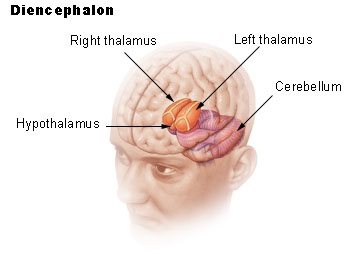
Image courtesy of https://en.wikipedia.org/wiki/File:Illu_diencephalon_.jpg Puclic domain image.

The arcuate nucleus (present in the hypothalamus) monitors leptin levels in the blood. Responses to the these levels are mediated by the neuropeptides (αMSH and CART) released by the neurons of the arcuate nucleus. As these neurons extend to numerous parts of the nervous system, the effects of a change in leptin level can be widespread. An increase in these levels lead to an increase in TSH and ACTH release from the pituitary gland (which raises the body’s metabolic rate), and an inhibition of feeding. In contrast, a decrease in leptin levels stimulate arcuate nucleus neurons containing neuropeptide Y and AgRP. This leads to an inhibition if TSH and ACTH release and stimulates feeding behaviour.
MCH and orexin are additional neurotransmitters whose release is increased in response to a decrease in leptin levels. They both stimulate feeding behaviour.
The role of Serotonin
Serotonin is the ‘good mood’ neurotransmitter, which rises on eating. High serotonin levels increase satiety, which explains why drugs which increase serotonin levels are good candidates for appetite suppressants (ie. diet pills). Serotonin is probably one of the reasons we get enjoyment out of eating and may be accountable for ‘comfort eating’.